
Last Updated: 11/07/2024
If you’re able to get your content ranking as a featured snippet, you can give your SEO and organic click-through-rate a serious boost, as a featured snippet gets approximately 8% of all clicks. In this guide, we’ll cover what featured snippets are, and how you can optimise your content to get them.
What are Featured Snippets?
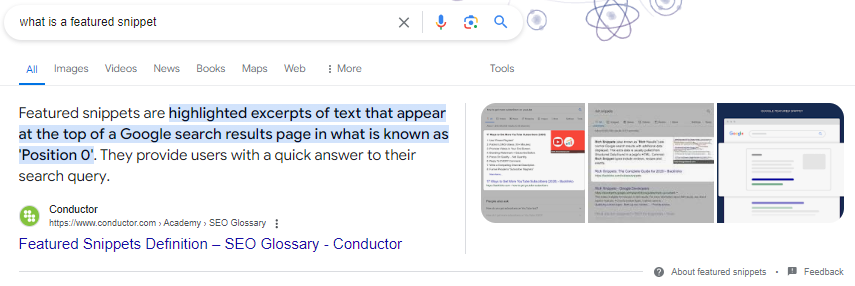
Featured snippets are short pieces of content that appear at the top of Google’s organic search results in order to quickly answer a searcher’s question. For this reason, they’re especially helpful for those on mobile or searching by voice.
Featured snippets are technically classed as “Position #0” because it appears above the traditional #1 spot on search results. You might also find featured snippets within the “People Also Ask” section or along with Knowledge Graph information
Featured snippets get approximately 8% of all clicks, which can give your click-through-rate a significant boost. In addition, as featured snippets are bigger than standard blue links, you’ll consistently get more view of your content and brand.
Put Blog Writing Into Practice With Our SEO Essentials Course
Our new course is built for solopreneurs, freelancers, and small business owners who want to build a strong SEO foundation, including how to write SEO optimised blogs effectively to drive meaningful traffic.
How to Get Featured Snippets
Google’s automated systems determine whether a page would make a good featured snippet to highlight for a specific search request. While we don’t know the exact workings behind Google’s systems, there are certain optimisations you can make to increase your chances.
1. Do Your Keyword Research
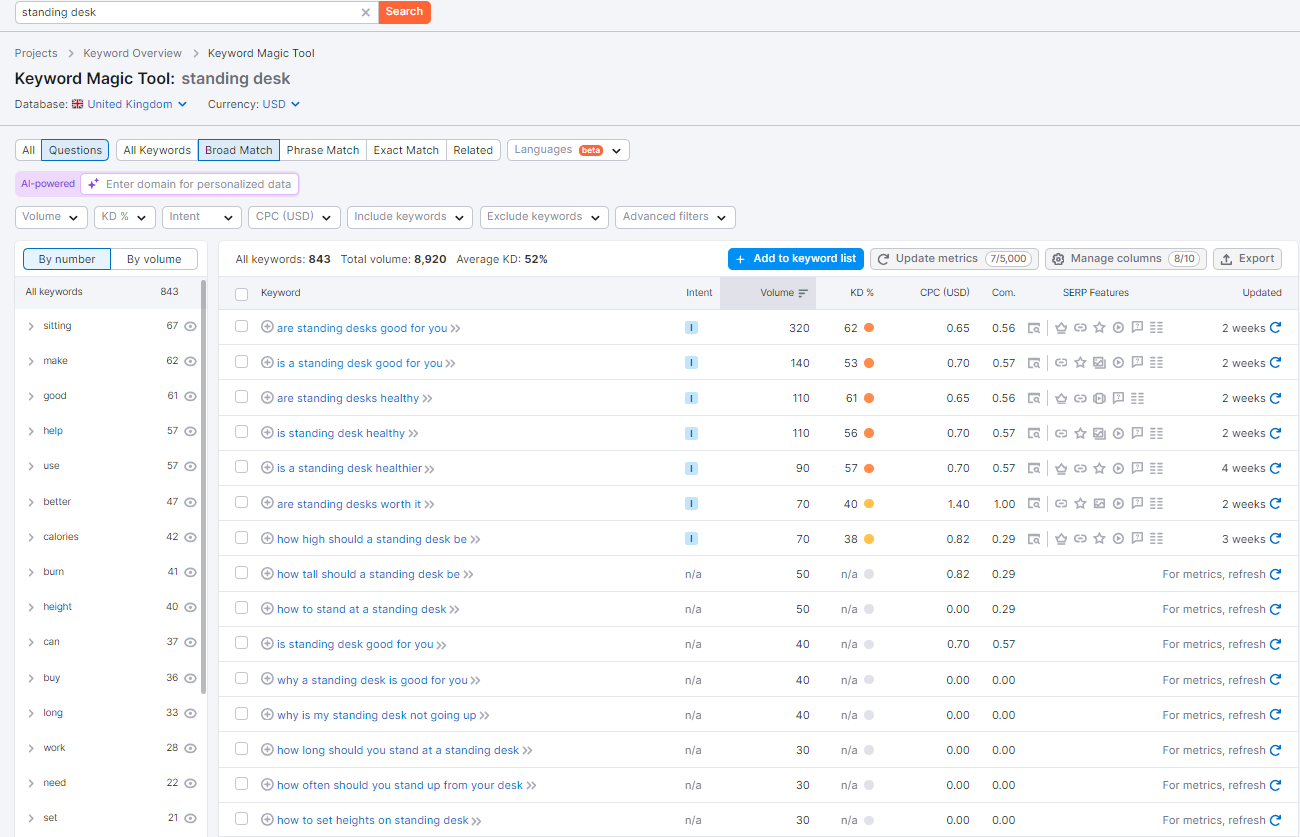
First things first, you must conduct keyword research to discover what trending keywords/topics your prospective customers are searching for. Once you have found your keywords, determine from the search results page, otherwise known as the SERP, what queries return a featured snippet. Then you know what searches that Google wants to (and will) show a featured snippet for.
According to Semrush data, the more words in the query, the higher the chance of the SERP returning a featured snippet.
When reviewing the SERP, you can also determine what kind of featured snippet is being returned. Is it a standard snippet of text, or is it in a list format? Understanding what Google wants to show to users, and therefore what it deems useful for answering the search, can help improve your chances. More on that below.
There are a number of keyword research tools available. At Lumen, we like to use the Semrush Keyword Magic Tool as it provides us with insightful information about each trending keyword, including the ability to focus in on keywords with a featured snippet. We also use AlsoAsked, a tool that provides you with live data on questions from real user searches. The long-tail keywords you get from this tool are particularly valuable, helping to quickly improve your content’s usefulness.
It’s important that you use the provided keyword metrics to help you make your decision. For example, if your site is relatively new or lacks an established web presence, it’s best to opt for keywords with a low search volume. This is because, in general, the higher the volume, the harder it will be to rank for that keyword.
2. Write Valuable Content That Answers a Question
To rank for a featured snippet, focus on creating blog content that directly answers specific questions. Search engines, like Google, often serve as a place for people to ask questions, and featured snippets frequently appear for question-based searches.
In fact, research by Semrush shows that 29% of keywords that triggered a featured snippet started with a question-based word, such as why, do and can.
3. Avoid Brand Mentions
Featured snippets are designed to quickly answer a searcher’s question. Use of your brand name or first-person language in general can make this harder for the searcher. For example,
“At DeskPro, we believe standing desks provide numerous benefits. Our customers have reported that DeskPro standing desks help reduce back pain and improve mood. Many users also find that our desks improve their productivity levels.”
Shifts the focus to the brand itself rather than answering the searcher’s question.
“Standing desks have several proven benefits for the user, including reducing back pain, improving mood, and increasing productivity levels.”
Gives a straightforward answer, making it easier for the searcher to understand the benefits without any distraction or perceived bias, increasing the chances of a featured snippet.
4. Format Your Content
There are a number of different ways you can rank as a featured snippet. The most common are: paragraph, list, table, and video. As mentioned above, understanding what kind of content Google returns for a featured snippet for set searches will help you optimise your content.
Paragraph
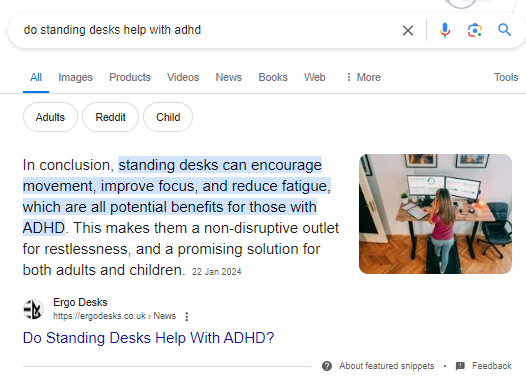
70% of featured snippets are formatted as a paragraph, with an average of around 42 words and 250 characters. Most of these featured snippet titles start with what, why, are, can and do, and lots of these answer the question within the featured snippet. There is a common misconception that you must write a “What Is X?” H2 tag at the beginning of the article, but featured snippets can be pulled from elsewhere.
List
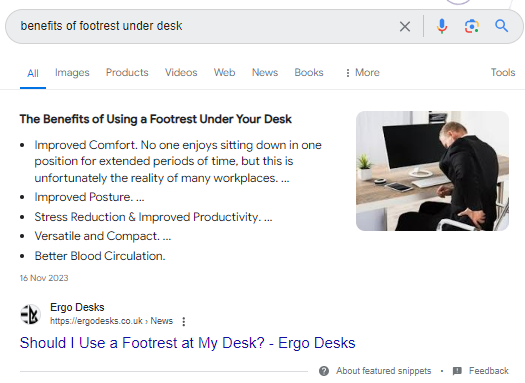
An average of 19% of featured snippets are in a list format, with an average of 6 items and 44 words. Lists can be bulleted or numbered, and are most successful when derived from how, why and benefits keywords.
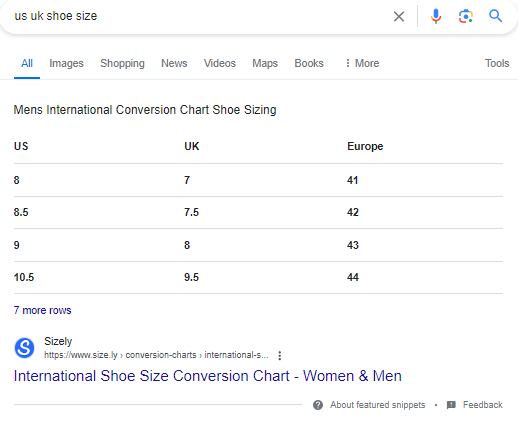
Table
Approximately 6.3% of featured snippets are formatted as a table with an average of five rows and two columns with 40 to 45 words. These help users to make comparisons by visualising the data within the SERP. To optimise for this type of featured snippet, we recommend marking up relevant content in a table format using the table tags in HTML.
Video
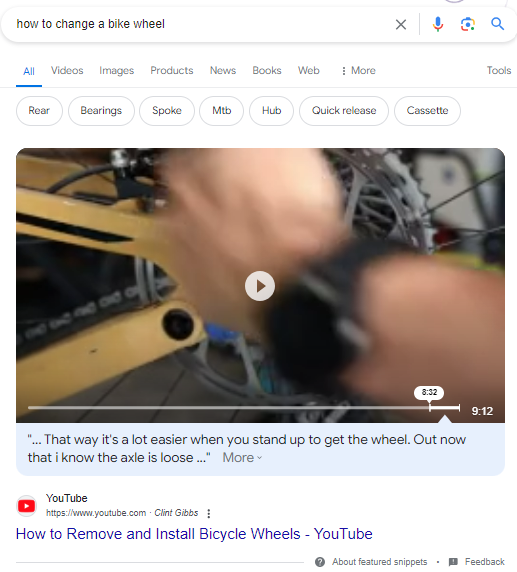
Around 4.6% of featured snippets are video, with the average one being 6 minutes and 35 seconds long. This stresses the importance of a multi-channel marketing approach; you won’t be able to rank written blog content for all search terms, so video content on YouTube could increase your chances of ranking for certain keywords, depending on their intent.
5. Optimise Your Content
As well as providing a valuable answer to the reader, it is absolutely essential that your content is search engine optimised in order to rank highly on Google. Indeed, previous studies have shown that the higher you rank, the better your chance of claiming one. Prioritise opportunities where you rank in the top 5/10 first, and then work on improving the value of your other content to get it to rank first, before even thinking about a featured snippet. Here are some ways you can improve the value of your content for Google and readers:
- Match the existing snippet format with the right intent – your content must be the most relevant result for the search.
- Update metadata – Write a catchy title and informative description that will be shown on the search results. Remember to include your keyword.
- Optimise headings – Utilise H2’s, H3’s & H4’s to help structure your content and improve user experience.
- Write simple sentences and avoid first-person or self-serving language.
- Use the language of your audience – Google uses featured snippets as answers in voice search.
Most importantly, focus on providing the best experience for your readers and not just Google. Ask yourself, as Google recommends, if your content is helpful, reliable and people-first.
- Does the content provide original information, reporting, research, or analysis?
- Does the content provide a substantial, complete, or comprehensive description of the topic?
- Does the content provide insightful analysis or interesting information that is beyond the obvious?
- If the content draws on other sources, does it avoid simply copying or rewriting those sources, and instead provide substantial additional value and originality?
- Does the main heading or page title provide a descriptive, helpful summary of the content?
- Does the main heading or page title avoid exaggerating or being shocking in nature?
- Is this the sort of page you’d want to bookmark, share with a friend, or recommend?
- Does the content provide substantial value when compared to other pages in search results?
- Does the content have any spelling or stylistic issues?
- Is the content produced well, or does it appear sloppy or hastily produced?
- Is the content mass-produced by or outsourced to a large number of creators, or spread across a large network of sites, so that individual pages or sites don’t get as much attention or care?
You should also revisit your on-page SEO, such as addressing penalties, making sure your website is easy to navigate for users and Googlebots, ensuring your website is fast and mobile-friendly, improving your internal linking structure and using user-friendly URLs.
If you’re certain that you’ve fulfilled the above and Google still isn’t ranking your content as a featured snippet, keep trying! Test other iterations or make other, minor adjustments to see if that makes a difference. You should also look for opportunities to “best” the existing snippet; can you use even more concise phrasing or highlight different, more up to date facts? Can you write something that is more valuable for readers than what is up there?
How Do You Track a Featured Snippet?
You’ve made all the required edits, but how do you know if you’ve got a featured snippet? There are both free and paid options to help you track a featured snippet.
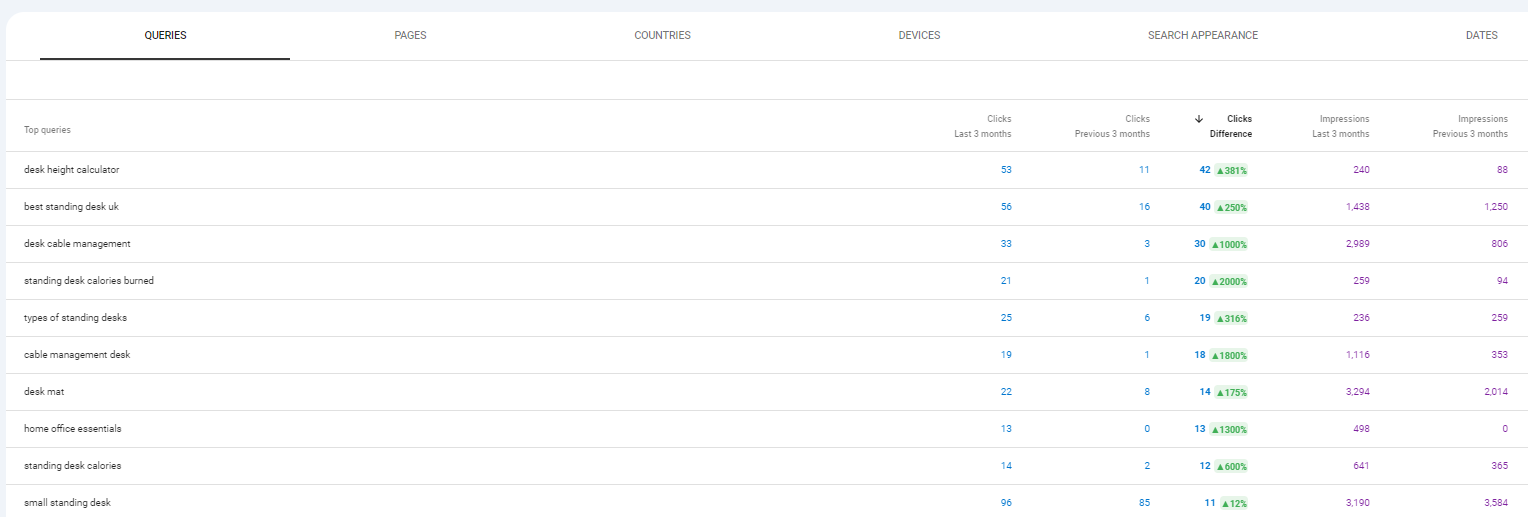
The first is Google Search Console, a free tool that offers valuable insights into how your site performs in search results. By analysing the Performance > Search Results report, you can see the queries that lead to your site appearing in search results. While it doesn’t explicitly show featured snippets, increased clicks and impressions for specific queries might indicate snippet placement, which you can manually check by searching for the keyword on search. Using the compare tool can help you to better determine what queries are growing the fastest.
Otherwise, several SEO tools offer features specifically designed for tracking featured snippets. The most popular ones include:
- SEMrush: This tool provides a position tracking feature that identifies if your website holds a featured snippet for specific keywords.
- Ahrefs: With site explorer and rank tracker, Ahrefs can show you which of your pages have featured snippets.
- Moz: Their keyword explorer and ranking features can help you track and analyse featured snippet performance.
Conclusion
In conclusion, by understanding what featured snippets are and implementing targeted optimisations, such as through keyword research, creating valuable content, avoiding brand-centric language, and properly formatting your content, you can improve your chances of ranking in the coveted “Position #0.” Remember to continually refine and update your content for both readers and search engines, ensuring it is helpful, reliable, and people-first.
Need additional help with getting featured snippets? Get in touch with our SEO team on +44(0)77110 52211 or email Aled at aled@lumenseo.co.uk. Alternatively, you can message us on our LinkedIn or Instagram pages.
If you like the sound of working with us, we also offer free, no obligation SEO audits on websites. To claim yours, simply enter your details here and we’ll get a free SEO audit to you.